Showing posts with label sprouts. Show all posts

Mar 13, 2015

Carrot and Alfalfa Salad

When did winter zoom past? Nobody knows. Not only is summer on us but it is exam season too. That means two things – light refreshing meals and hydration. When spending time over the stove top is a agony, we must think smart and eat sensibly. Salads are great additions to a meal and good at quenching thirst also. Salads are great even for snacking in between meals.

Salads are mostly made of raw vegetables and fruits which have a higher moisture content. Since there is no cooking involved, the vegetables retain their juices and nourishing properties to the fullest. For more on how to make or when to not have salads, read through my article here.

So, are alfalfa sprouts good for you? Here is the lowdown on alfalfa sprouts.

These are a great source of protein, B complex vitamins, Vitamin K, Calcium, Iron, Potassium, Zinc, Copper. Also high in phytoestrogens. Traditionally used to treat  kidney ailments, diabetes, these wonder sprouts also mop up cholesterol from arteries. Great news for people with high cholesterol, or arterial plaques. While they are a wonder food for most people, some sets of population may have to proceed with caution.

Pregnant women or convalescent people are better off eating all foods that are cooked, avoiding any raw sprouts including alfalfa. Since the sprouts mimic estrogen, women with low progesterone may do well to avoid eating it daily. People who have auto immune disorders such as Rheumatoid Arthritis, Multiple Sclerosis, or Lupus may find an increase in their symptoms with prolonged daily consumption of these sprouts.

It is also useful too remember that this caution is only necessary if you plan to eat raw alfalfa sprouts daily for several months. In an otherwise balanced diet that includes alfalfa sprouts once a week or thereabouts, in combination with a variety of other foods, the food only delivers its abundant vitamins and minerals with no significant damage due to its phytoestrogen, canavanine, or other components.

Carrot and alfalfa salad

This is a salad I rustled up for lunch today. I feel it looks colourful, happy and enticing. I’ve even added a surprise ingredient to encourage the younger ones to reach out for it eagerly. Want to know more? Read on for the recipe….

ALLERGY INFORMATION

  • Does not contain gluten, lactose, dairy, corn, soya, yeast, eggs.
  • Suitable for gluten or lactose intolerant people.
  • *Contains nuts. People with nut allergy can omit the nuts in this recipe.

Preparation time – 15 minutes + 30 minutes chilling time, Cooking Time – nil,  Serves – 2 main servings or 4 as accompaniment to meal

You Need -

Cookware – Peeler, Grater, Knife, Mixing Bowl, Mortar and pestle

Ingredients -

  1. 1 cup grated red carrot (I used 1 long red carrot)
  2. 1/4 cup thinly sliced onion
  3. 1 fistful alfalfa sprouts
  4. 1 cup chilled drinking water
  5. 1 green chilli OR 1/2 tsp crushed black pepper
  6. 1/4 tsp salt
  7. 2 tbsp apple cider vinegar
  8. a 1” square of peanut brittle or any nut brittle* (optional)

Method -

  1. Rinse the alfalfa sprouts in running water and steep in the chilled drinking water until needed.
  2. Immerse the thinly sliced onion in the vinegar. Set aside.
  3. Rinse, scrub, peel and grate the carrot. Slice the green chilli into thin slanting slivers.  Coarsely crush the peanut brittle in a mortar and pestle. Do not powder it. Leave behind some small bits for your kid to pick up and and bite into with glee!
  4. Place all the ingredients in a mixing bowl, drain water from the sprouts, add to the bowl, and give them all a good toss with salt. You may need to separate the sprouts with fingers.
  5. Chill before serving for flavours to marry each other well.

Phulka, Rajma and Salad - balanced meal

Mar 5, 2013

Sprouts In Palak Gravy

Reposting the recipe as entry to Only Cooking with Legumes event at Nalini’s Kitchen. A great event started by Pari Vashisht at her blog Foodelicious

March is the season of winter in some places, spring in some parts of the world, and summer in several parts too! One season is common to all in India – March is the season of exam fever all over the country! Rising temperatures, portions to complete, revise, projects to submit, cramming before exams, and raging hormones no less, all add to the Indian teenager’s agony. Standing at an important crossroad of life, today’s teenager and the family have a lot of stress to face through these weeks.
At such stressful times, it goes without saying that a healthy body and healthy mind are very crucial to crack the tests and come through happily. Parents are eager to know what can help in improving their children’s health and will do all it takes to better their child’s chances at success. I have had several parents ask me about ideal diet for children during study holidays and examination - time. An ideal diet at these times should include plenty of fibre, vitamins and minerals and less of refined starches. Greasy, spicy foods are best avoided too. Fruits, fresh squeezed citrus fruit juice without too much sugar, other fluids like tender coconut water do wonders to keep the body and mind stable and calm. It also helps to spend some time in playing  a favourite game and / or doing breathing exercises like ‘Pranayama’ (after learning from a qualified teacher).
Let us begin with good food. Food that is nourishing, sustaining, and tasty too! Food that energises without being heavy, food that delivers maximum effect with minimum effort. What can fit this bill better than sprouts?
I am quite fond of sprouts for their power packed nutrient content. Sprouts are an invaluable source of protein in a vegetarian’s diet. Besides the protein punch, sprouts are also chockfull of Vitamins B (better digestion, stronger nerves), Vitamin C ( better immunity, healthier gums). Also present are Minerals like Zinc, Copper, Iron – These are needed for a growing teen for stronger muscles, more blood cells and hence more oxygen to body and brain! Sprouts are low on glycemic index too. They are the perfect food for holistic health – of mind and body.
While it is true that raw sprouts give all the benefits of vitamins, fibre, minerals, yet it is not an easy task to coax children to chew on them frequently.If you can get your teen to chew on a tbsp of raw mung bean sprouts daily, it would be wonderful. However. do not despair if she does not agree. I often choose the middle path – steam the sprouts, or microwave them for a brief while to take the raw offensive flavour out. Steaming sprouts also is good to help elderly or people with compromised immunity to digest it easily.
Eating cooked sprouts is better than not eating them at all. Eating cooked sprouts in a smooth flavourful palak gravy is even better. What say?
Parathas made with multi grain dough flavoured with ajwain paired well with this sprouts in palak gravy. It was school lunch fare and I am so glad to say that other kids at school liked it too. This is an ideal meal for children working hard at their academics at this time of the year.
Bowl of Sprouts in Palak
You need
  1. Mixed sprouts or mung bean sprouts – heaped, 1 cup
  2. Palak leaves – wash in several changes of water, drain, chop and measure – 3 heaped cups
  3. Onion – chopped, 1/4 cup
  4. Garlic – 1 clove, crushed
  5. Tomato – chopped, 1/2 cup
  6. Green chilli – 2
  7. Root ginger – chopped – 1 tbsp
  8. Salt – 1 heaped tsp
  9. Garam masala powder – 1 tsp
  10. Oil – 1 tbsp + 1/2 tsp
  11. Jeera – 1/2 tsp
To Assemble
  1. Pressure cook mixed sprouts or mung bean sprouts for as much time as needed to be just cooked. The cooking time will depend on the bean. Set aside, for pressure to release. Alternately, if you are using only mung bean sprouts, just steaming them for 3-4 minutes would be good too.
  2. Heat 1 tbsp oil in a non stick pan or kadhai.
  3. Add in this order, each at a 30 second interval   – garlic, ginger, green chilli, onion and tomato. Add salt, let the tomatoes mush up. Fry ingredients in oil
  4. Add chopped palak leaves. Toss the palak well in the pan, let it wilt and cook for about 2 minutes. Add chopped palak
  5. Cool and grind to a smooth paste.
  6. To the same pan, add 1/2 tsp oil, Sizzle jeera in it.
  7. Tip in the palak puree and the cooked sprouts, add garam masala. Check for salt, add more if needed. Mix palak puree and cooked sprouts
  8. Simmer for 3-4 minutes, switch off cover and let flavours mingle for 10 minutes or more. DSC_0042
  9. Serve warm with a lime wedge if you like, as accompaniment to hot phulkas or steamed rice. Yum. SmilePower Packed Meal

May 31, 2012

The Serendipity Sundal


“Mom, what’s for lunch?” Startled, I looked up the clock to see it was just 10 minutes to our lunch time. I was deeply immersed in some cleaning chore and had lost count of time. So here I was with a bowl of boiled sprouted peas and some steamed rice. I had 10 minutes to turn these into lunch!  I work best under pressure. (I mean, when –time–is–running-short kind of pressure, and not the boss-down-my-neck kind of pressure) The sundal I assembled proved this right!  A bowl of yummy goodness was the result. The side dish worked well with chilled curd rice. So why serendipity? I was searching for an idea for a quick side dish and wound up with this filling, tasty, nourishing dish!
 
What’s good about this dish?Peas and  corn
  • Sprouts are real, live, complete, nutrient packed, power houses.
  • Pea sprouts are rich in Vitamin A, B, C, E, the minerals Calcium, iron and all essential amino acids.
  • While pressure cooking does take away some nutrients, sprouting and cooking renders the protein easily digestible, ensures it is well absorbed, and prevents discomfort due to indigestion. So this is a good cooking method for people with IBS, Mal absorption syndrome.
  • Sprouts are vital for teenagers, people engaged in active sports, pregnant and breast feeding mothers, weight-watchers and for body builders.
  • Including sprouts in a vegan /vegetarian diet improves the protein quality of the meal.

You needall dressed up!
  1. Red onions –  dice and measure 1 heaped cup
  2. Capsicum – chop and measure 1/2 cup ( I used green, red or yellow would work well too)
  3. Frozen /Fresh corn kernels – 1/2 cup
  4. White peas sprouts – 1 level cup
  5. Fresh /Frozen coconut – grated, 2 tbsp
  6. Green chilli – 3
  7. Garlic – 1-2 pods
  8. Salt – 1 level tsp
  9. Turmeric powder – 1/2 tsp
For seasoning
  1. Cooking oil – 1 tbsp
  2. Mustard seeds – 1 tsp
  3. Cumin seed – 1 tsp
  4. Coriander leaves – chopped, 2 heaped tbsp
To assemble
  • Pressure cook white peas sprouts until soft, but not mushy.
  • Heat oil in a fry pan / kadhai, add mustard seeds and cumin.
  • When it splutters, add diced onions fry well till light brown (you can add 1/2 tsp of sugar while frying to get the onions taste sweet).
  • Tip in the diced capsicum, corn kernels, toss well.
  • Once the veggies look ‘fried but not wilted’(in about 2 minutes), toss in the cooked peas.
  • Add salt and turmeric powder, mix well. Cover for a minute.
  • Make a  coarse powder of coconut, garlic and green chilli in the mixer. I just used the ‘pulse’ button a couple of times. Add this to the peas and mix in well.
  • Top off with chopped coriander for a very fragrant, healthy dish.

Variations
  • You can add/omit veggies used in this recipe.
  • Add a zing to the dish by squeezing in lemon juice after cooking.
  • Add fennel seeds/saunf to the seasoning to give a nice twist to flavour.
  • Use parboiled peas and corn with raw onion, capsicum and shredded carrots for a colourful salad.
The Serendipity Sundal - up close


Sending this hearty dish to Renuka's ongoing event 'Salad splendour'

Apr 1, 2011

Power Pesarattu

Pesarattu is a much loved dish of Andhra or Telugu region of India. I have adapted the ingredients to suit my family’s taste. The use of sprouts and herbs in the batter create a unique power packed combination, easy and amazingly tasty.The herbs helped in masking a slight bitter flavour that sprouts develop. This dish works just right for breakfast in our home. I hope you find it great too! The measures used here serve 5-6 people.
Power Pesarattu
You need   
  1. Mung bean sprouts – 4 cups, heaped
  2. Raw rice – 1/2 cup, rinsed and soaked for 1/2 hour
  3. Ginger – 1 tbsp, chopped fine
  4. Green chillies – 2
  5. Coriander leaves – 1 cup, chopped
  6. Mint leaves – 1 cup, loosely packed
  7. Cumin seeds – 1 tsp
  8. Garlic – 1 pod (optional)
  9. Salt – 1 tbsp ( or more)
  10. Fresh water – 1 cup
  11. Vegetable oil / sesame oil  - 4-5 tbsp, for drizzling over dosas
mint, cumin, ginger, chillisprouts, rice, and coriander


To assemble
  1. Grind all ingredients mentioned under ‘You need’ except oil, to a real smooth batter. I used a mixer grinder. Using garlic gives a ‘kick’ to the final taste, but omitting it does not take away the pleasure either.
  2. Use water sparingly for grinding. The batter should be thinner than usual dosa batter but not too runny.smooth, frothy batter
  3. Hereon, writing the recipe is fairly simple, but creating a good dosa / pesarattu does need some practice!
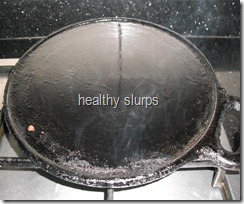
  4. Heat up a dosa griddle real hot. You can see the griddle all smoked up in this picture. Season the griddle with a tsp of oil.
  5. smokin hot
  6. Dribble a ladleful of batter around the griddle, fill up the centre with more batter, and spread very gently to form a circle. Drizzle 1/2 tsp of oil around the dosa, let it sizzle.Mummy look, a green dosa!
  7. Allow to cook through and brown around the sides, ease out the dosa carefully with a sharp spatula and flip over. flip over
  8. Cook this side over medium heat, ease out and remove to a plate when done.
  9. Check the dosa for salt and flavours before proceeding with the rest of the batter. To  salvage a runny batter or too much salt, you could add up to a couple of tbsp of rice flour to the batter. Rice flour will also help the Pesarattu become more ‘flippable’ and less clingy to the dosa griddle.
I did ruin a couple of dosas before I got it right. It helped to have the griddle smoking hot, waiting for the first side to really brown before attempting to loosen it and thereon, cooking over medium heat.
Pesarattu is traditionally served with ginger chutney. I usually serve with a peanut chutney which is a great favourite with my kids.
power pesarattu
Notes
  • Soak, drain, rinse whole mung bean and tie up in a muslin cloth, leave in a moist dark place for 10-12 hours, by which time the seeds would have sprouted and you have super healthy sprouts ready.
  • Mung bean sprouts have been used in Ayurvedic approach and Chinese cuisine for several centuries.
  • Consuming raw sprouts is not advised for toddlers, pregnant women, and in any gastrointestinal disturbance. The ideal way to consume for these people would be to use home  grown sprouts, rinse well, steam or lightly stir fry them.
Nutri notes
  • The sprouting process increases the beans’ enzyme content which means, complex carbs are converted to simpler starches, proteins to amino acids and fats to simpler lipids. As a result sprouts are more easily digested.
  • Sprouting increases sodium and Vitamin C content, both of which add to protein digestibility in the body.
  • Sprouts are 'live' food. They contain active RNA, DNA, in addition to being a veritable enzymes and antioxidants storehouse. They help cell regeneration and can rightly be called ‘fountain of youth’.
  • Dry beans do not have any vitamins or minerals, but we get almost magical amounts of Vitamins A, B, C, Calcium, Sodium, Potassium, Iron, Phosphorous, Manganese, from sprouts. Thus they are very handy in winters when fresh fruits or vegetables are in short supply. Sprouts can be eaten the whole year through too, for the whole host of amazing benefits.
  • Sprouts decrease the oligosacharides in the beans – this means, beans lose their gas producing quality.
  • Sprouting also increases fibre and water content of the beans, thus helping in avoiding or easing constipation.
  • For benefits of pudina and coriander, please do read up my earlier posts.

Dec 24, 2010

Quick chana kurma

An easy-to-cook, hearty dish just right for this season! It is also loaded with all nutrients you can wish for in a power-packed meal. Once you have read through the nutri notes, I’m quite certain that everyone will try this dish out. Do let me know how it worked for you.If you have sprouts ready at hand, this delicious kurma takes no time in travelling from the pot to the tummy!
dinner!
You need green chana sprouts
  1. Green chana sprouted – 1 cup heaped
  2. Salt – 1 tsp heaped
  3. Turmeric powder – 1/2 tsp
  4. Fresh coriander leaves – 1/4 cup chopped
  5. Jaggery –1 tbsp powdered (optional)
  6. Sambar powder – 1 tsp (optional)
For seasoning
  1. Vegetable oil – 1 tbsp
  2. Mustard seeds – 1 tsp
  3. Curry leaves – 10 leaves torn up ingredients
  4. Hing powder – 1/2 tsp (if you are not using onion or garlic)
For the gravy
  1. Ripe tomatoes – 4 medium, or 3 big
  2. Chutney dal – 2 tbsp levelled
  3. Fresh coconut – grated 1/4 cup
  4. Ginger – chopped fine 2 tbsp
  5. Green chillies – 2-3
  6. Garlic – 1-2 cloves (optional)
To assemblesteaming kurma
  1. Pressure cook chana sprouts until well cooked. Sprouting renders the legumes softer and you can cook it faster.
  2. Grind all ingredients mentioned under gravy  to a smooth paste.
  3. In a thick bottomed pan, heat oil, add ingredients for seasoning in order.
  4. Pour in the gravy paste, add 1 – 2 cups of water, add salt and turmeric powder, bring to a boil.
  5. Once the gravy starts boiling, reduce flame, stir well and simmer for 10 minutes, keep stirring in between to avoid burning.
  6. When gravy is ready, tip in the cooked sprouts, check for salt.
  7. Add jaggery and sambar powder, if using.
  8. Adjust salt and consistency if needed by adding water.
  9. Garnish with fresh chopped coriander and serve hot with rotis, rava idli or steamed rice.
droooly kurma ready!
Nutri notes-
  • The key ingredients in this dish are sprouts and ginger. So, I shall confine the nutrition information to these two.
  • Sprouting or germinating whole pulses has been known to man for several thousands of years.
  • Sprouts have the starches pre-digested by the enzyme amylase activated during sprouting. This breaks down starches into simpler sugars, proteins into amino acids and complex fats into simpler fatty acids, by the action of enzyme lipase.
  • Sprouts of legumes therefore are easier to digest than the dry forms, their flatulence (gas) producing factors decrease and the protein in the legume is available to the body in a more absorbable form.
  • Sprouting decreases levels of trypsin (amino acid) inhibitors or protease (digestive enzyme) inhibitors (present in the legumes - these substances make the legume harder to digest)
  • Sprouting increases the availability of water soluble vitamins such as Vitamin B and C by 400% to 800%.Hence it is ideal for growing teens, pregnant and lactating women, and elderly people –all groups of people whose needs for vitamins are higher.
  • Sprouting increases presence of calcium and phosphorous making it important for women past age of 35 years too.Moreover sprouts contain plant oestrogens, very essential for women in peri-menopause or pre- menopause or menopause stages. In other words – from ages 35-60 and even beyond! These plant oestrogens help maintain bone density, hence help prevent osteoporosis.The hormone also helps to relieve symptoms of PMS, hot flushes during menopause.
  • Sprouting helps to increase presence of anti oxidants in foods – this prevents free radical formation.Result – skin ages slower, tissues remain stronger through age, hence better vision, hearing, better muscles and stronger bones too!
  • Sprouting increases iron and zinc content of legumes. Both minerals are vital during growth phase of children.
  • Sprouts being ‘live’ food are considered full of ‘prana’ or life-force.Hence, better immunity, anti ageing properties, detoxifying in nature, maintains acid – alkaline balance of the body.
  • Ayurveda recommends using of ginger and turmeric in dishes of legumes to maintain acid balance and improve digestability of the dish – this recipe thus has it all !