Showing posts with label aval. Show all posts

Jul 31, 2017

Poha Alu Tikki

Finding myself with a big bowl of leftover Kanda Poha, I was wondering what to upcycle it as. It seemed such a shame to throw away such precious organic red poha. Thus was born Poha Alu tikki. Since rice flakes (Poha) is so quick to soak, and because the tikki is easy to put together with readily available ingredients, I am sure you will enjoy making and savoring this simple Poha Alu Tikki as much as we did.

You can use either Red or White Poha for this Poha Alu Tikki. Or you can use up leftover Aval upma/Kanda Poha like me! Just add a boiled potato for binding, some herbs and seasonings, and the Poha Alu Tikki is ready to be pan fried and gorged upon.

Here is how I made Poha Alu Tikki.
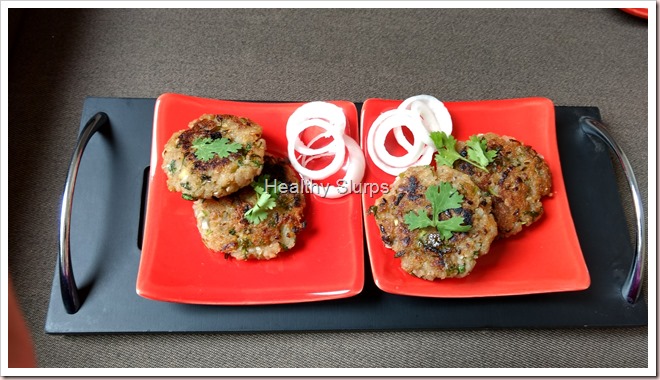
Tikki platter

ALLERGY INFORMATION

  • Does NOT contain lactose, nuts, soya, corn, egg.
  • Suitable for people with gluten allergy or lactose intolerance,

Preparation Time -  15-20 minutes, Cooking Time –  25–30 minutes, Makes – 12 –14 medium size tikkis. 

YOU NEED

COOKWARE – colander, 5 litre mixing bowl, chopping board, knife, potato masher, non-stick tawa/griddle

INGREDIENTS

  1. 1 heaped cup Red/ White rice flakes ( poha). I used *Red Poha. OR 1 heaped bowl leftover aval upma/Kanda Poha
  2. 1 medium potato boiled, or half cup boiled mashed potato
  3. 1/4 cup finely minced red onion
  4. 2 green chillies, finely minced
  5. a handful of fresh coriander leaves,finely minced
  6. 1/2 teaspoon salt
  7. 1/2 teaspoon amchur powder
  8. 1/2 teaspoon garam masala powder

METHOD

  1. If using fresh rice flakes(Poha), cover with fresh water, soak for 5 minutes. Then place in a colander and rinse under running water. Set to drain.
  2. Clean and mince finely onion, green chilly, and coriander leaves.
  3. Add the above to the drained poha, mashed potato, salt, amchur and garam masala in a mixing bowl. Mash them together using a potato masher. Mix well to a homogenous mixture.
  4. Make big lemon size balls, flatten slightly, and shallow fry on a heated non-stick tawa. Drizzle as little oil as possible while shallow frying. Flip to other side, and cook till browned. Take care to brown both sides evenly.
  5. Remove to serving plate. Serve with onion rings and mint chutney.

Tikki close upTikki close up 2


Sep 6, 2015

Aval Payasam

Wishing all readers a happy Janmashtami. Praying for more love, peace and happiness in all your homes.

“Pathram Pushpam Phalam Toyam Yo Me Bhaktya Prayachati Tad Aham Bhaktyupahritam Ashnami Prayatatmanaha.” “If one offers to me with Love and devotion, a leaf, a flower, a fruit or water, I will accept it.” Bhagwad Gita, 9.26.

The humble aval, poha, beaten rice has a legendary status in Lord Krishna’s life. His childhood friend, Sudama, redeemed himself by offering a handful of beaten rice when they met after several years. It is said that Lord Krishna relished this offering of Love and Surrender so much that Sudama’s poverty stricken home was turned into a palace of riches, after the Lord accepted this offering.

Here is a recipe for Aval Payasam for Janmashtami. Let us try to make it and offer it to the Lord with single-minded devotion and Love. For He is most fond of a devotee’s Love.

Payasam fit for the Gods 

ALLERGY INFORMATION

  • Contains milk (lactose). Not suitable for lactose intolerant people.
  • Does not contain gluten, soya, corn.

Preparation time – 10 minutes, Cooking time – 30 minutes,  Serves - 4

YOU NEED

COOKWARE – Heavy bottomed sauce pan, ladle

INGREDIENTS

  1. 1/4 cup red aval/poha/beaten rice*
  2. 1 litre whole milk
  3. 1 cup sugar
  4. 1/4 teaspoon ghee

METHOD

  1. *Aval can be thick or medium aval. Do not use thin flat aval. If using thick aval, rinse under running water and soak for 10 minutes. If using medium aval, rinse under running water and add directly to boiling milk.
  2. Bring the whole milk to boil in a heavy bottomed sauce pan. Once the milk is on a rolling boil, drain water from the soaking aval, and add the soaked/rinsed aval to the milk. Keep stirring over low to medium flame to avoid charring at the bottom of the pan. Keep mashing the aval as you stir. This lends a creamy texture to the payasam.
  3. When the milk is reduced to half its volume, switch off flame and add sugar. Stir in the sugar gently until fully dissolved.
  4. Return milk to flame, keep stirring over medium to high flame for 4-5 minutes more.
  5. Switch off flame and cover with a tight lid.
  6. Add 1/4 teaspoon of ghee before offering this to God.
  7. Creamy aval payasam tastes good hot or at room temperature.

Red Aval Payasam

Feb 20, 2011

Lemon Poha / Aval

The humble aval / avalakki / poha at its tangy best. An anytime meal / snack, kids and adults alike love the tang, the crunch of peanuts and it’s inviting colour. What I love best about this dish is the nutritive punch it delivers.
lemon poha
You need rinsed poha
  1. Medium thick poha – 2 cups, heaped
  2. Lemons – 2
  3. Turmeric powder – 1 tsp
  4. Hing powder – a good pinch
  5. Salt – 1 tsp or more
  6. Sugar – 2 tsp or more (optional)
For seasoning ingredients for seasoning
  1. Vegetable oil – 2 tbsp
  2. Mustard seeds – 1 tsp
  3. Urad dal – 1 tbsp
  4. Chana dal – 1 tbsp
  5. Peanuts – 2-3 tbsp
  6. Curry leaves – 7-10, torn up
  7. Green chillies – 3-4, slit lengthwise
  8. Coriander leaves – chopped, 3/4 cup
To assemble
  • Wash the poha under running water in a colander, allow the water to drain, set aside. 
rinsed poha in colander
  • Heat oil in a deep sauce pan, add ingredients for seasoning in order, save coriander leaves for later.
mustard crackling in oil  add urad dal,chana dal,peanutsadd curry leaves,chillies,hing and turmeric
  • Add the rinsed poha now, tip in sugar, salt, coriander leaves in this order and gently fold the mixture to avoid squishing the poha.
fold in poha gently
  • Now is when you can squeeze in juice of two lemons (you can increase or decrease quantity of juice as suits your taste). Fold in the mixture with a gentle hand until poha, lemon juice and seasonings are well incorporated.
Your tangy poha is ready to be gobbled down.
Tasty, tangy poha
Variations
  • This is my basic version of lemon poha. You can add any or all of these vegetables to the seasoning mixture to add variety to the dish – chopped green or any coloured capsicum (peppers), grated carrot, boiled green peas.
Nutri notes
When compared to raw rice -
  • Rice flakes /poha have twice the calcium  and three times the fibre content. 
  • Poha also has thrice the thiamin (Vitamin B1) and twice the niacin (Vitamin B ) content.
  • The absolute stunner comes from the whopping 20 times more iron than in raw rice!! Add to this the availability of copper too, poha is a nutrient storehouse.It is a valuable food for those who are – anaemic, sportspeople, teenagers, pregnant or lactating women.
  • With the presence of Copper at  0.37mg /100gm in poha, and with the addition of lemon juice (Vitamin C) in this recipe, the dish is an excellent iron source especially for vegetarians. Reason – Copper and and Vitamin C are necessary for iron absorption in the body.
  • Addition of dals and peanuts also add to the protein content of the meal, apart from adding texture.
  • The dish can be made more wholesome by adding boiled green peas (protein), boiled corn, capsicum or shredded carrots(vegetables).
I hope I have conveyed the importance of using poha in our weekly diet well enough. Do let me know what you think about the nutrition information I have given here.